
By Randal Terrell
As someone who earned a Bachelor of Arts in Criminology from the University of Texas at Dallas, I have spent years studying the causes of criminal behavior and the various theories that attempt to explain why people commit crimes. Through my academic studies, personal experiences, and observations of the mental health system, I have come to believe that neither free will nor determinism alone can fully explain human behavior.
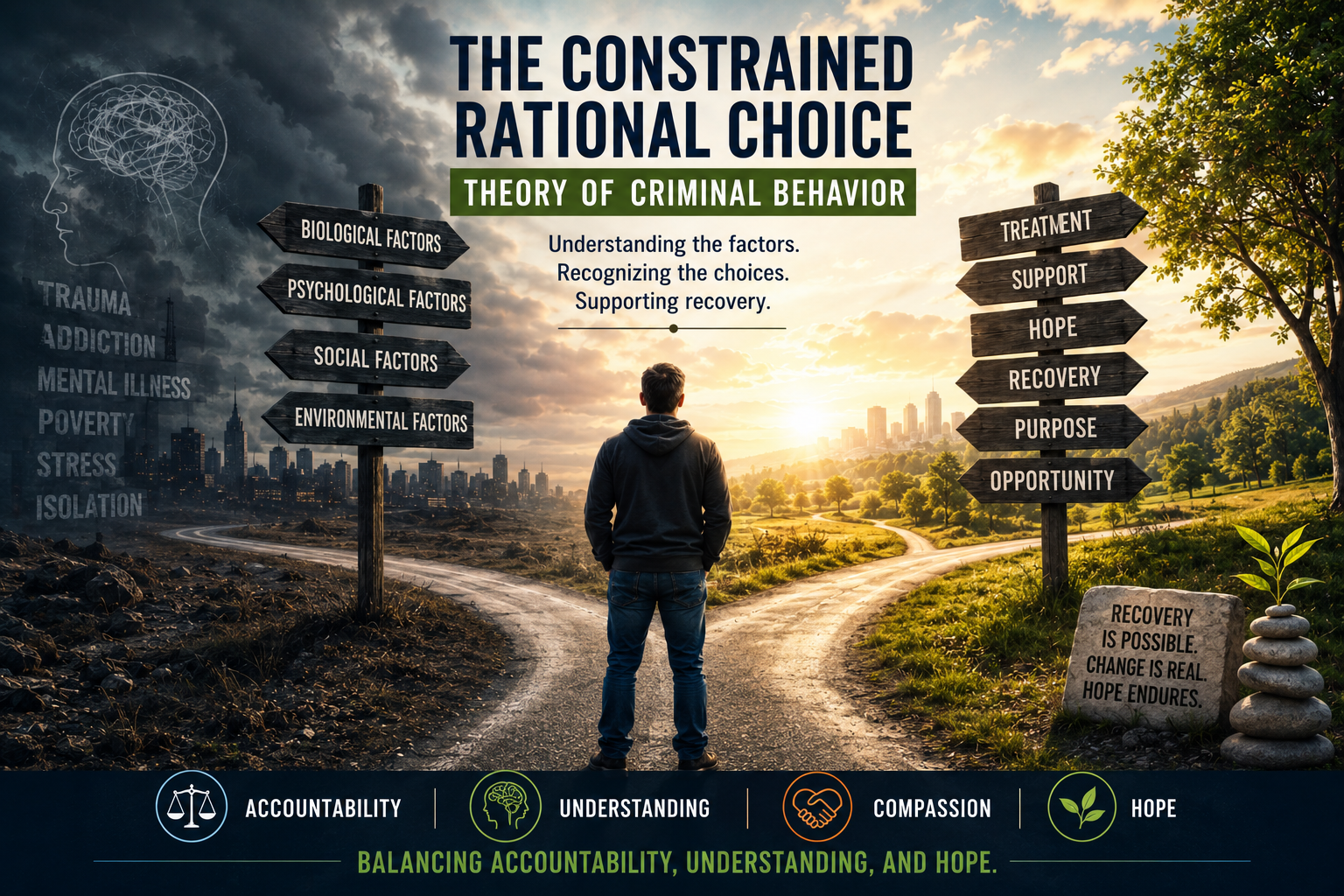
This belief has led me to develop what I call The Constrained Rational Choice Theory of Criminal Behavior.
Understanding Crime Through Two Different Lenses
Historically, criminologists have debated whether criminal behavior is primarily the result of free choice or forces beyond an individual’s control.
The Classical and Neoclassical Schools of criminology emphasize personal responsibility. These theories suggest that people generally make rational choices and should be held accountable for their actions. The Neoclassical School, however, recognizes that factors such as age, mental illness, intellectual limitations, and extraordinary circumstances can reduce a person’s ability to exercise full free will.
The Positivist School takes a different approach. It argues that criminal behavior is heavily influenced by biological, psychological, and social factors. According to this view, people do not always choose crime freely. Instead, they may be influenced by genetics, brain function, trauma, mental illness, substance abuse, poverty, or environmental pressures.
I believe both schools contain important truths.
The Constrained Rational Choice Theory
The Constrained Rational Choice Theory proposes that criminal behavior emerges from the interaction between personal decision-making and the factors that shape or limit that decision-making.
Most people possess the ability to make choices. However, the quality of those choices can be significantly affected by conditions beyond their control.
A person suffering from severe psychosis may not perceive reality accurately. Someone experiencing extreme trauma, addiction, brain injury, or overwhelming stress may not evaluate risks and consequences in the same way as a healthy individual.
Under this theory, responsibility exists on a continuum rather than as an all-or-nothing concept.
People should be held accountable for their actions, but justice systems should also recognize when biological, psychological, and environmental factors have substantially impaired a person’s judgment.
Applying This Theory to Mental Illness
My interest in this topic extends beyond criminology.
Mental illness is often discussed as if it is entirely biological or entirely psychological. In my view, recovery requires recognizing that the human mind is influenced by many interconnected factors.
Mental illness may involve:
- Brain chemistry
- Physical health
- Sleep quality
- Chronic stress
- Trauma
- Substance use
- Social isolation
- Financial pressure
- Family relationships
- Environmental influences
- Personal beliefs and thought patterns
When multiple risk factors accumulate, an individual’s ability to think clearly and make sound decisions can become constrained.
This does not mean the person is weak or incapable. It means they are operating under conditions that make healthy decision-making more difficult.
My View of Recovery
One of the most important lessons I have learned is that recovery should not be viewed as a destination. Recovery is a process.
Just as criminal behavior can result from multiple interacting factors, recovery often requires improvements in multiple areas of life.
Recovery may involve:
- Professional treatment
- Medication when appropriate
- Counseling
- Peer support
- Physical exercise
- Better nutrition
- Improved sleep habits
- Reduced substance use
- Spiritual growth
- Meaningful relationships
- Purpose and personal goals
No single solution works for everyone.
The goal is not perfection. The goal is progress.
Every positive change strengthens a person’s ability to make healthier decisions and improves overall mental wellness.
Hope and Human Potential
Perhaps the most important implication of the Constrained Rational Choice Theory is that people are more than the worst decisions they have ever made.
Human beings are capable of growth.
People can learn.
People can heal.
People can recover.
Understanding the factors that influence behavior does not excuse harmful actions. Instead, it helps us develop more effective approaches to prevention, treatment, rehabilitation, and recovery.
Whether we are discussing crime, addiction, depression, anxiety, or serious mental illness, I believe society benefits when we focus not only on accountability but also on understanding, treatment, and hope.
When people are given the opportunity, support, and tools to improve their lives, many can achieve outcomes that once seemed impossible.
That belief in recovery, growth, and human potential remains at the heart of both my criminological perspective and my personal mission to support mental health and addiction recovery.
Leave a Reply