By Randal Terrell
My Theory on Life
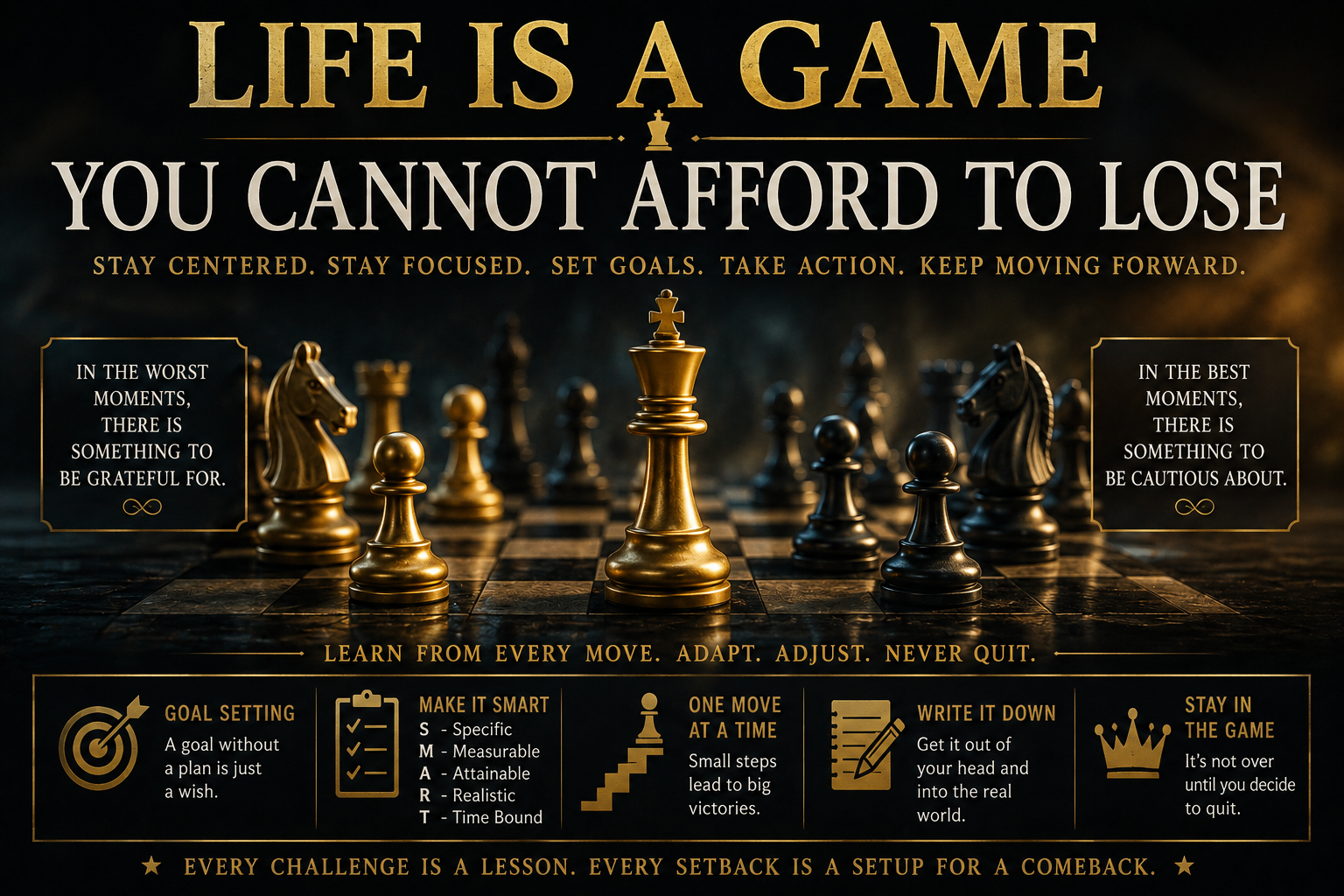
Over the years, I have developed a simple theory about life: life is a game that you cannot afford to lose. I do not mean that life is a competition where we have to defeat everyone around us. I mean that regardless of what happens, we have to find a way to stay in the game. We have to learn from our experiences, adjust when circumstances change, control the things we can control, and continue moving forward. My perspective did not come from everything in my life going according to plan. It developed through obstacles and experiences that changed the direction of my life, including my time in the military, physical injuries, marriage and divorce, years in the county jail, years in a state hospital, and the process of rebuilding my life afterward. Perhaps the biggest lesson these experiences have taught me is that nothing is ever quite as good or quite as bad as it seems in the moment.
Finding Gratitude During the Worst Times
During some of the worst moments of my life, it would have been easy to believe that everything was terrible and that nothing positive could possibly come from what I was experiencing. Yet even during extremely difficult circumstances, I eventually learned that there was usually something for which I could be grateful. Sometimes gratitude is easy. When life is going well, we can be grateful for family, freedom, opportunities, health, friendships, accomplishments, or simply waking up to another day. Finding gratitude becomes much harder when life is not going according to plan, but I believe those are also the times when gratitude becomes most important. Even during difficult circumstances, there may be something we still have. It could be another opportunity tomorrow, someone who cares about us, a lesson we are learning, food to eat, a place to sleep, our faith, or simply the knowledge that our current circumstances do not necessarily represent our future. I have learned not to assume that a bad chapter means the entire story will be bad.
Keeping Perspective During the Good Times
The opposite is also true. When everything seems to be going perfectly, I try not to become so excited that I stop thinking clearly. Good opportunities can still involve risks, success can create overconfidence, and excitement can sometimes cause us to make decisions we would not make if we were thinking more carefully. That does not mean we should not enjoy the good moments in life. We absolutely should. I simply believe there is value in remembering that circumstances change. When things are going badly, I try to remember that they can get better. When things are going exceptionally well, I try to remember not to become careless. For me, the goal is balance.
Learning to Stay Emotionally Centered
One of the most important things I have learned about myself is that I make better decisions when I remain emotionally centered. I try not to become too excited about one event or too devastated by another. That is easier said than done, but it is something I continue working on. When my emotions get too far out of balance, I can miss opportunities. When circumstances are terrible and I allow myself to become overwhelmed by sadness or frustration, I may become so focused on what has gone wrong that I fail to recognize an opportunity to recover, adapt, or learn from what I am experiencing. The same thing can happen when I become overly excited. If I convince myself that an opportunity cannot possibly go wrong, I may stop asking important questions or overlook warning signs. Remaining centered does not mean becoming emotionless. Happiness, sadness, excitement, disappointment, grief, and hope are normal parts of being human. My goal is not to eliminate those emotions. My goal is to prevent a temporary emotion from making permanent decisions for me.
Staying in the Game
This is where my belief that life is a game you cannot afford to lose becomes especially important. In a long game, one bad play does not necessarily determine the final outcome. You adjust your strategy and keep playing. You learn what went wrong, protect yourself from making the same mistake again, and look for the next opportunity. Life can work the same way. A failed relationship does not have to mean a failed life. A career setback does not mean there will never be another opportunity. A period of confinement does not necessarily determine what someone does with the rest of their life. An injury may change the road we travel without eliminating every possible destination. Sometimes winning simply means refusing to quit. There are times when the best move may be to advance toward a goal, while at other times the best decision may be to stop, reconsider the situation, change direction, or rebuild. What matters is continuing to participate in our own lives instead of allowing one event to convince us that the game is already over.
The Importance of Setting Goals
Another important lesson I have learned is the value of setting goals. Wanting life to improve is not enough by itself. A person can spend years thinking about something they would like to accomplish without ever creating a realistic path toward achieving it. Goals give direction to our efforts, but even having goals is not enough. I have found that my goals are much more useful when they are clearly defined. One approach that has been valuable to me is the SMART goal method, which I learned through SMART Recovery. SMART stands for Specific, Measurable, Attainable, Realistic, and Time-Bound. Instead of simply saying, “I want my life to be better,” I need to decide what “better” actually means. What specifically am I trying to accomplish? How will I know whether I am making progress? Is the goal something I can realistically achieve? What steps are necessary? When do I intend to complete those steps? Answering these questions turns an idea into a plan.
Getting From A to Z
Large goals can become intimidating when we look only at the final destination. I think about this as trying to get from the letter A to the letter Z. If Z represents my ultimate goal, I cannot simply stare at Z every day and expect to magically arrive there. I have to complete B, C, D, and all the other necessary steps along the way. Sometimes this means breaking one large goal into many smaller goals. Those smaller goals may not seem impressive by themselves, but each completed step moves me closer to where I ultimately want to be. This approach also gives me something extremely valuable: evidence of progress. When I accomplish one small goal, I can look back and say, “I did that.” That accomplishment builds confidence. Confidence creates motivation, and that motivation makes me more willing to pursue the next step. Eventually, a collection of small accomplishments can become a major accomplishment.
Why Smaller Goals Matter
When I focus exclusively on one enormous goal that may take months or years to accomplish, it can begin to feel impossible. I may work for a long time without feeling as though I have achieved anything because I am measuring myself only against the final destination. Breaking the journey into smaller steps allows me to recognize that progress is occurring long before I reach Z. Instead of waking up every morning worrying about how far away the final goal seems, I can concentrate on the next achievable step. Every step completed becomes proof that I am moving forward, even if I still have a long way to go.
Why I Write My Goals Down
I have also learned that writing my goals down is extremely important. When a goal exists only in my mind, it can change along with my mood. On an optimistic day, I might create an enormous goal. On a difficult day, I might convince myself that the same goal is impossible. If I continually rewrite the destination according to whatever I happen to be feeling, it becomes difficult to measure real progress. Writing the goal down creates something concrete. For me, putting an idea on paper is one of the first steps toward moving it from the abstract world of thought into the real world.
Our minds can sometimes feel like a hamster wheel. Ideas go around and around. We think about what we want to do, what we should have done, what could go wrong, and what might happen someday. We can spend tremendous amounts of mental energy thinking without actually moving anywhere. Writing something down interrupts that cycle. Now the idea exists outside my head. I can read it, evaluate it, break it into steps, establish a deadline, and most importantly, take action. Writing a goal down does not guarantee that I will achieve it, but it transforms the goal from something I am merely thinking about into something I can begin working toward.
Progress Creates Motivation
I have come to believe that motivation does not always have to come before action. Sometimes action creates motivation. If I wait until I feel completely motivated before beginning something difficult, I may wait forever. But if I establish a small, realistic goal and complete it, the accomplishment itself can motivate me to continue. One completed step becomes evidence that another step may be possible. This principle has become especially important to me during recovery and while rebuilding different areas of my life. Instead of expecting everything to change immediately, I can concentrate on the next realistic action. I can ask myself what I can accomplish today, what I can accomplish this week, and what the next step is between where I am and where I want to be. Those questions are much more useful to me than constantly worrying about how far away the final destination appears.
Learning From the Bad Without Missing the Good
Looking back over my life, some experiences that seemed terrible while I was going through them eventually taught me important lessons. That does not mean I would choose to repeat every painful experience or pretend that suffering is somehow good. It means that once something has happened, I have a choice about what I do with the experience. I can allow it to exist only as something that hurt me, or I can also ask what it can teach me. What did I learn about myself? What would I do differently? What strengths did I discover? What mistakes do I want to avoid repeating? Is there something I understand today that I did not understand before? Finding a lesson does not erase the difficulty of an experience. It simply means the experience does not get the final word.
My Formula for Moving Forward
My theory on life continues to evolve as I do, but several principles have remained consistent. I try to remember that difficult circumstances are rarely permanent. I try to enjoy success without allowing excitement to interfere with good judgment. I work to remain emotionally centered so that temporary feelings do not cause me to miss long-term opportunities. I set goals, break large goals into smaller SMART goals, write them down, and use each accomplishment as motivation for the next step. Most importantly, I try to stay in the game. Life will have victories and losses. There will be periods when everything seems to be moving forward and others when progress seems almost impossible. There will be unexpected opportunities and unexpected obstacles. The challenge is not to make sure that nothing bad ever happens, because that is impossible. The challenge is learning how to respond when it does.
Life Is a Game You Cannot Afford to Lose
After everything I have experienced, I have learned not to judge my entire life based on one moment. The best day of my life does not guarantee that tomorrow will be easy, and the worst day does not mean tomorrow cannot be better. When things are going well, I try to remain grateful, cautious, and focused. When things are going badly, I try to look for the lesson, the opportunity, and the next step forward. I cannot always control the hand I am dealt, but I can continue working on how I play it. I can set another goal. I can take another step. I can learn another lesson. I can make another adjustment. I can get back up after a setback and continue moving toward something better. That is what my experiences have taught me about life: stay centered, stay grateful, set goals, write them down, take the next step, learn from what happens, and above all, stay in the game.
Leave a Reply